A First-Light Walk Through a Familiar Street
A first-light walk through a familiar street shows how shopfronts, pavement traces, and early activity shape a neighborhood before its usual routines begin.
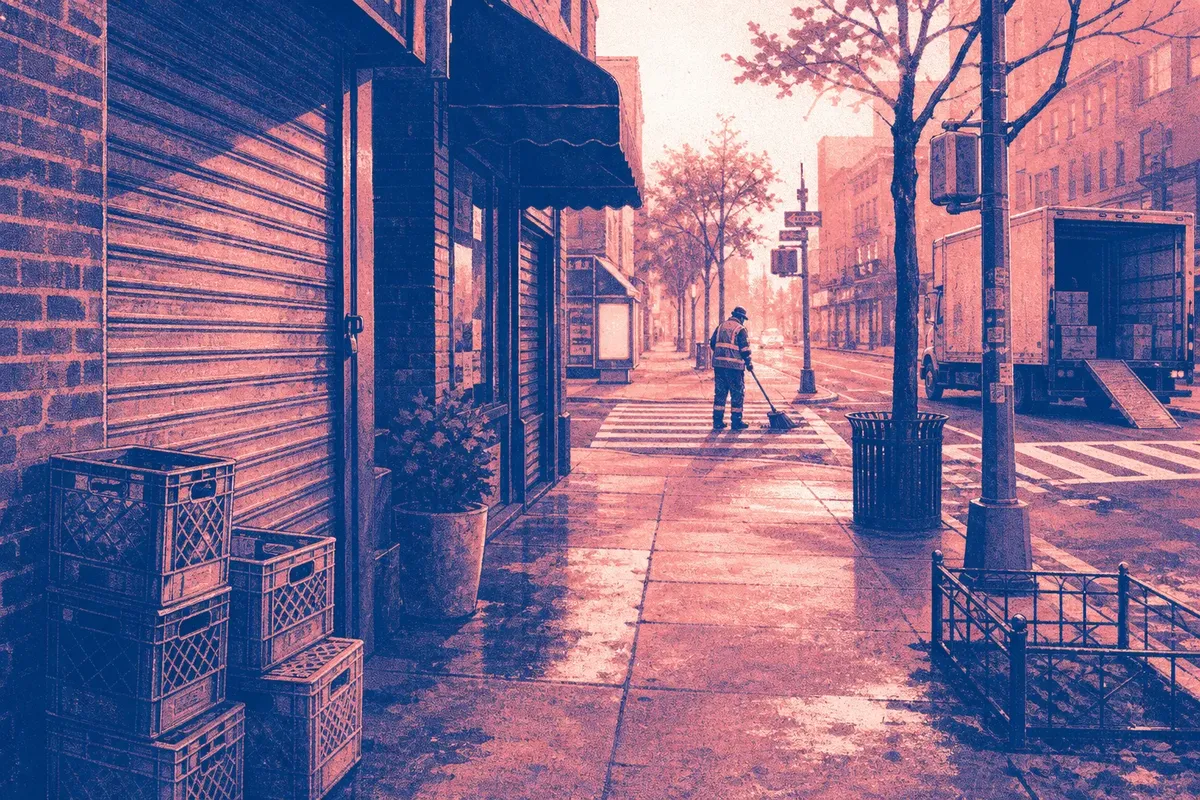
A first-light walk through a familiar street is most revealing when you pay attention to its edges: the boundary between sidewalk and storefront, public space and private doorway, quiet and the first signs of work. A short route can show how shutters, delivery setups, and street-cleaning traces shape a neighborhood before its usual routines begin.
Imagine leaving home just before dawn to walk one block on public sidewalks and return along a nearby street. Instead of tracking changes in the sky or comparing the same view, notice how the street is prepared for use: where a threshold is swept, how a shopfront meets the pavement, and which parts of the sidewalk remain open. Keep a respectful distance from entrances and leave people, businesses, and objects undisturbed.
Choose a route that keeps you on public sidewalks
Pick a short loop with clear public landmarks, such as a corner grocery, a bus stop, a tree well, and a crosswalk. Familiar streets are useful because you can focus on their practical details without searching for the route. Avoid alleys, private courtyards, and entrances that would require you to leave the sidewalk.
Before setting out, choose a few observations that concern the street’s use rather than its changing light: clear walking space, storefront boundaries, signs of maintenance, and objects placed near the curb. Treat the route like a place setting: each item has a position, and the arrangement can tell you how people are making room for one another.
Read storefront edges without guessing what happens indoors
A shutter, grille, glass door, or recessed entrance marks a different kind of boundary. Notice its material and how it meets the sidewalk, but do not infer a business’s schedule or activity from a closed door. A sign, a locked gate, or a dark window is only a visible feature, not an invitation to investigate.
Look at the space immediately outside a storefront. A swept strip, a planter, a stack of crates, or a delivery notice may show how the entrance is arranged for daily use. Keep the observation descriptive: “crates beside the wall” is more reliable than guessing who placed them or when they will be moved.
Notice how maintenance leaves traces on the sidewalk
Street surfaces show where routine care meets weather and foot traffic. A clean patch near a doorway, leaves gathered at a curb, or a damp mark below a drain can draw attention to how the public space is maintained. These details do not reveal who did the work or why, so avoid turning a visible trace into a story about a particular person.
At a crossing, remain clear of the curb ramp and look for the features that help people move through the block: tactile paving, a smooth approach, an unobstructed path, or a bin positioned close to the walking line. If something appears blocked or damaged, do not move it yourself; use the appropriate city or property reporting channel if action is warranted.
Keep the walk considerate and safe
Stay on the sidewalk, make room for other pedestrians, and avoid photographing people or looking through windows. If you use a phone to note a detail, stop somewhere that does not obstruct the path and keep your attention on your surroundings. Follow posted signs and local access rules, especially around construction, loading areas, and transit stops.
- Observe whether the sidewalk has a clear walking path; if it is open, continue on the public route, but if it is obstructed, use a legal accessible alternative rather than stepping into traffic.
- Observe whether a doorway or gate is clearly private; if it borders the public sidewalk, look only from outside, but if access is restricted, do not enter or peer inside.
- Observe whether a delivery or cleaning activity is underway; if workers need the space, give them room and pass when safe, but if the path is blocked, take another public route.
- Observe whether you can see and hear your surroundings while using a phone; if you remain attentive, make a brief note, but if the screen distracts you, put it away and continue without recording.
- Observe whether a photograph would make a passerby its subject; if it can be framed around an empty building detail, take it only where permitted, but if people cannot be excluded, skip the photo.
- Observe whether signs or barriers mark a work area; if the sidewalk is open to pedestrians, stay within the permitted route, but if access is closed, follow the posted detour.
What do readers ask about a first-light street walk?
How can I observe a street without taking notes?
Choose one concrete feature, such as a swept threshold or a stack of crates beside a shop wall, and describe it to yourself in plain terms. This keeps attention on what is visible without requiring you to track or interpret people.
What can I notice when every shop is closed?
Look at the different materials, signs, thresholds, and sidewalk arrangements along the block. Closed storefronts still shape how pedestrians move, but they do not tell you what is happening inside.
Is it appropriate to photograph a quiet street?
It can be, if photography is allowed and the frame focuses on public features rather than identifiable people or private interiors. If you cannot make that distinction, leave the camera away and observe without recording.
What should I do if an object blocks the sidewalk?
Do not move property or enter a work area to clear it. If you can safely pass using an accessible public route, do so; otherwise, take a different route and contact the relevant local service or property manager if the obstruction needs attention.
Work through a short route with clear decisions
Say you start at a corner grocery with a closed metal shutter, a clear sidewalk, and a few crates against the wall. You walk to the next crosswalk, notice leaves gathered beside the curb but no blockage, and see a cleaning worker using the far end of the block. You keep to the open sidewalk, leave the crates and leaves untouched, and give the worker space; on the return, you use the opposite side of the street because a delivery vehicle now blocks part of your original path. The result is a route shaped by visible access and activity, not by guesses about what the businesses are doing.
A first-light walk through a familiar street can be useful without turning the neighborhood into a scene to document. Keep your attention on public boundaries, maintenance, and clear passage, and let those observations guide where you walk and when you give others room.
Stay with the subject

Why the Sky Brightens Before the Sun Appears
Why the sky brightens before sunrise: understand how twilight light reaches you and distinguish a glowing…

Birdsong or City Hum: Two Ways to Notice an Early Soundscape
Learn to distinguish birdsong from city hum at dawn by noticing pitch, rhythm, and masking, so…